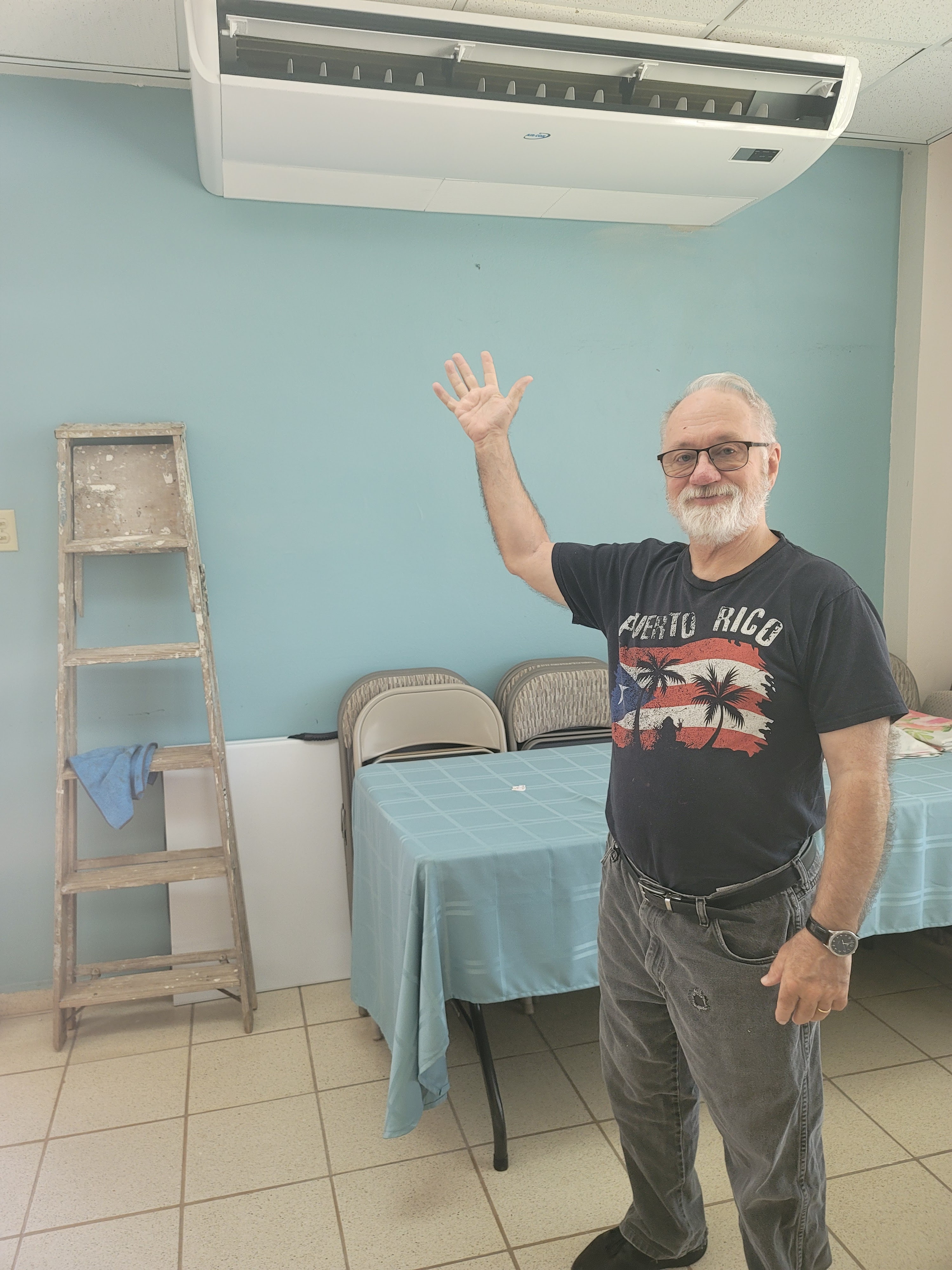
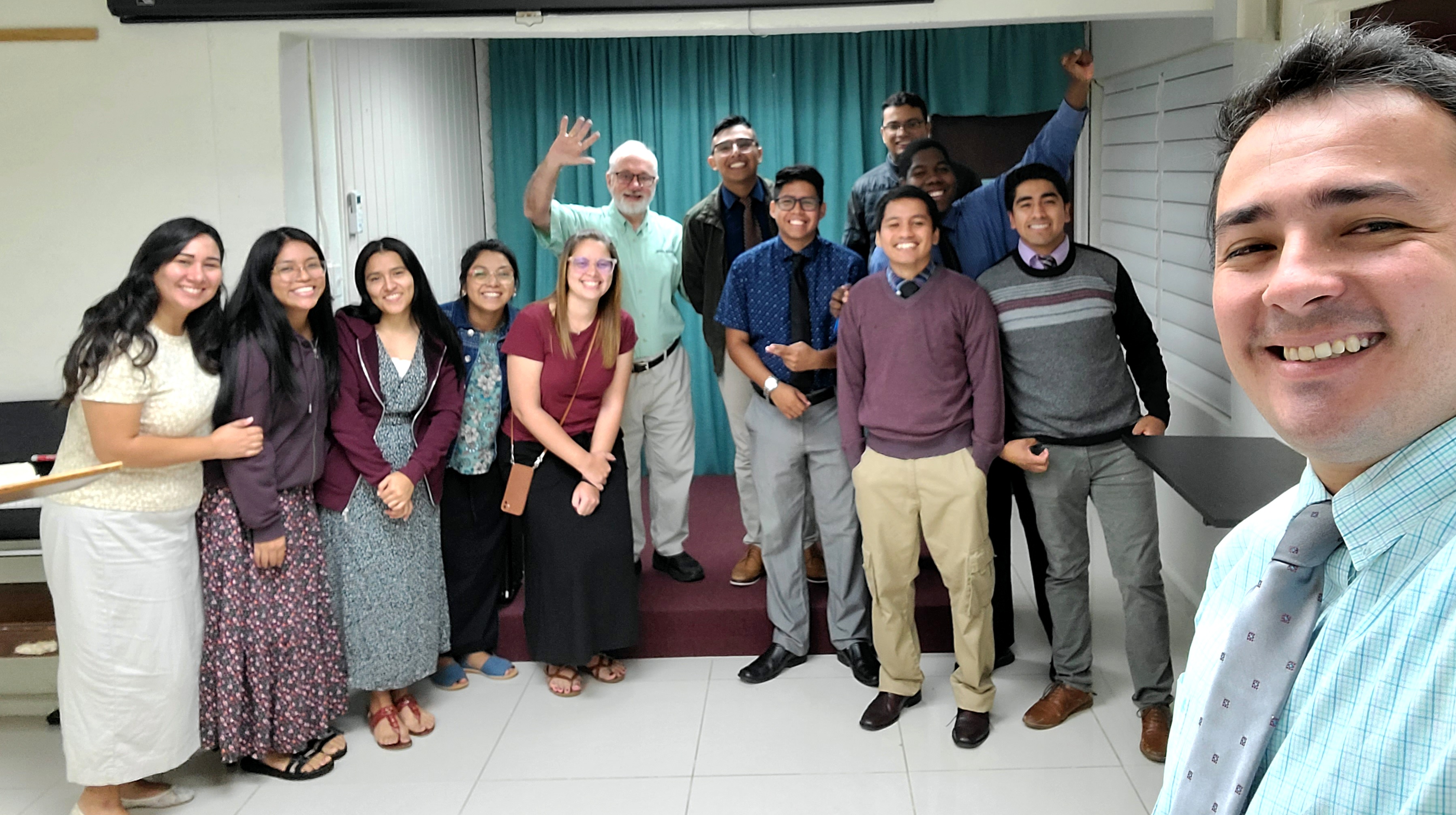
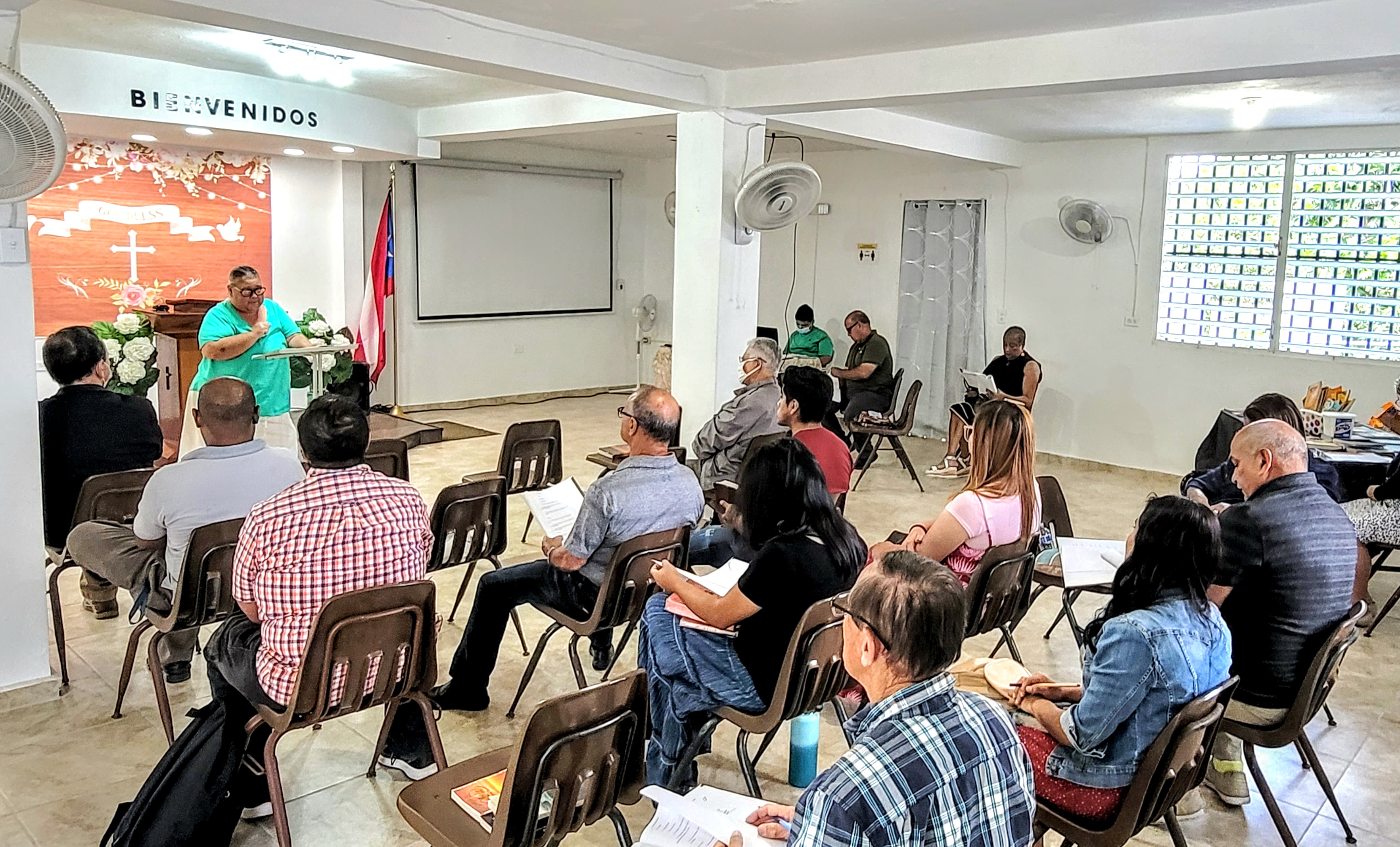
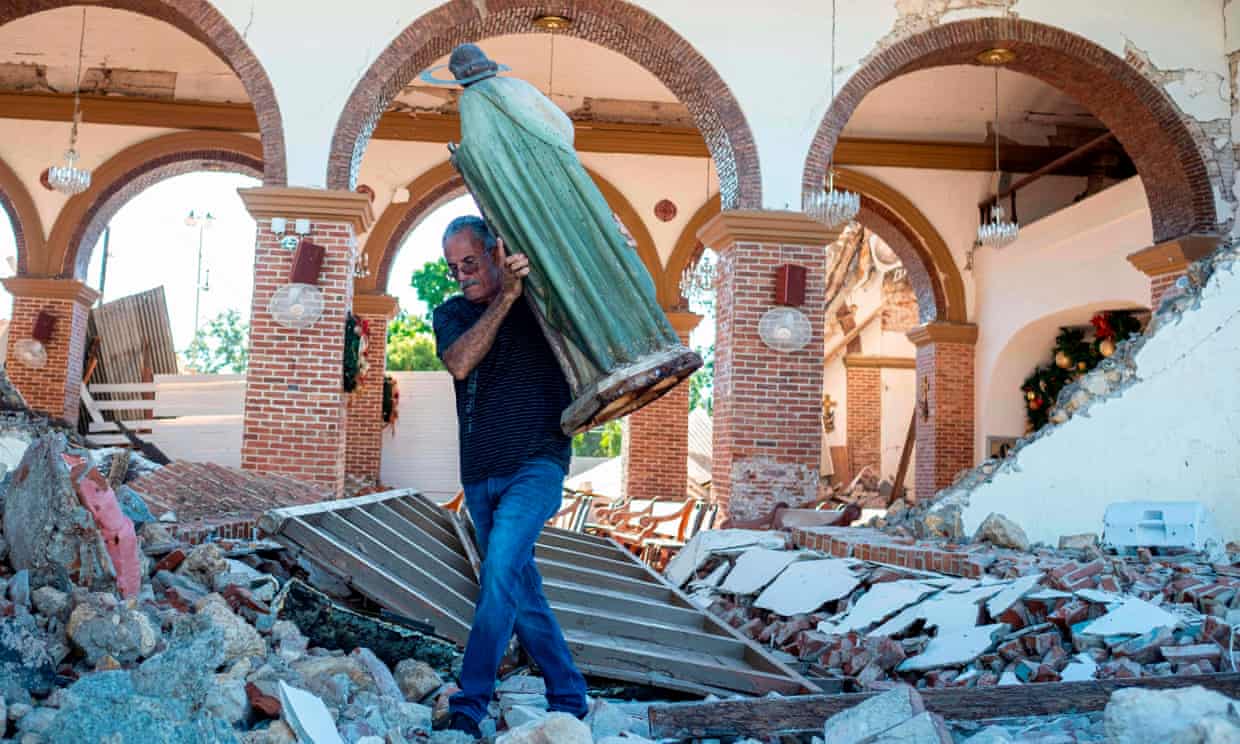
Puerto Rico: The Back Door for Reaching the US Spanish Speaking Population. Our ministry is Church planting and training men and women for Christian service at Puerto Rico Baptist College. We are reaching people here, who immigrate and reach others in Spanish speaking communities across our nation.
Come visit our family web pages at: http://www.OverlookedFields.com
1. First, I have my own personal devotions. I open "Our Daily Bread" and read the devotion they have, read the scripture and pray.
2. I check with my wife to see when she needs my help during
the day and schedule helping her and my study time for the best possible hours.
3. I select some background music for study. I like
"Solo Piano Radio" (http://solopianoradio.com/) or the "Music to Pray By" Podcast (http://www.musictoprayby.com/).
I make sure all interrupting electronic
devices are off. I have a stack of 3x5 cards for when I am tempted to be
distracted by my own random thought or questions. When they pop into my head, I
note them on a card so I can deal with them later, then I focus again on the
task at hand.
4. I open "e-Sword," a free Bible program that has
English, Spanish and other language Bibles, plus dictionaries and commentaries.
My old computer is getting cranky, so I might have to get a new one. Some days
I just use the Bible and 3x5 cards and some rubber bands. I have made some better
sermons that way, but they are hard to share when people ask me for a copy.
5. I begin in Spanish from the beginning, to avoid
translation pauses during my sermon delivery.
I open Microsoft Word 2010 and use it with a bilingual spell checking
dictionary.
6. I copy the verses I plan one using and paste them into
the Word document. Then I use e-Sword, and especially TSK (Treasury of
Scripture Knowledge) to expand on the themes in the text. I cut and paste the entire Bible verses listed
into the document, not just the references. I do this so that when I give the sermon and
the people are looking for the verses in their Bibles, I have the verses right
before my eyes and use those moments to gather my thoughts.
7. I look for a "Coherence Coordinator," a
unifying structure that will aid in presenting the message and in remembering
the message.
8. I look for illustrations, local proverbs, idioms or
stories that might serve as an introduction to the main theme of the sermon. I
like it best when the same illustration serves as the intro, provides the
structure and can be used in the conclusion to echo the introduction and tie
everything together well.
9. I run the sermon through my mind, asking these questions:
a. What do I want them to think? To feel? To do? B. Why should they care about
this? Show them how this makes a difference in their life. C. Does the topic
require motivation to some kind of action? If so, provide a “call to action”
and an opportunity to make a decision.
10. I try to make it all shorter. I ask myself, "If for
some reason I only had 10 min. to teach this, what would be the points I
wouldn't want to skip?" I mark those sections. If I am running short on
time, I can jump to those marked sections and still deliver a coherent message.
11. I stand up and preach it without apology or referring to
the time. If it is good or bad, they will know, I don't have to forewarn them.
If I have very little time, why waste it talking about the time? In the time it
takes to mention the lack of time, you can teach one more truth.
12. When I'm done, I remind myself that God can use what I
just preached any way He likes, whether I get praise for it or not. I
have preached sermons where I got a lot of praise, but then nothing happened.
On the other hand, some sermons that I have been embarrassed by have produced
amazing results. To God be the glory.
PS . If you don’t like my method, please show me how you do
it. I will be pleased to learn from your real life experience.
I found this funny article about a special kind of "Drug Problem" that would help our kids have a better life. Please comment if your parents ever "drugged" you in this way!
"For the first time, racial and ethnic minorities make up more than half the children born in the U.S.....348 of the nation's 3,143 counties, or 1 in 9, have minority populations across all age groups that total more than 50 percent." says CBS News
There is a very good reason churches should support missionaries that can help them reach the minorities in their own neighborhoods. These minorities are becoming the majority. Not only is it good policy to reach them for Christ, it is Biblical obedience to do so. Soon it might just be essential for the survival of the church itself. If the population of a city is replaced by one race and no evangelism has occurred, what will the future of our churches be in those communities?
I was blessed lately when I saw this. This girl can cook and paddles up and down the river inside her own cooking pot. She uses her wooden cooking spoon as a paddle. She uses the little she has to get what she needs to help those she loves. And she does it with a smile. I guess there will always be work for those who hustle and are creative. In my missionary experience, I meet a lot of people who promise to help us but never seem to get around to doing it. On the other hand, we are blessed greatly by people who sacrifice much and find creative ways to help. Out here on the field, far from home, friends and family, that help is profoundly felt.
It seems to me that if you really want to help someone, you won't allow circumstance to stop you. We didn't let circumstances stop us from coming to the mission field. I hope that someone who loves missions and missionaries might find a way to help us do the work of missions. And be happy that they did.
A man stood up in church Sunday and announced to everyone that he knew who had the most beautiful feet. He said that it was me because I had come to Puerto Rico to preach the gospel. He said it must be true because the Bible says: "How beautiful are the feet of them that preach the gospel of peace, and bring glad tidings of good things!" (Romans 10:15)
Well, I thanked him, but I kept my shoes on.
In fact my feet are a bit flat and get sore walking on the side walks and the cement or tile covered floors common to our island. We don't use carpet in the tropics, so walking about here takes a toll on your feet. I understood that he just meant to be appreciative of our efforts to reach them for Christ..
It is nice of someone to say that I have the best feet in the church, but I think we shouldn't compare our feet to see whose are the best. I think the people I teach have great feet, because they can carry the gospel to places I can't go. Instead of comparing them, I teach our people to use them.
Even the poorest people, without shoes can still have feet that are blessed by God if they are involved in his work. It is time we stood up and started using our feet to take the good news to those who need it.
Yes, you may have a tax return coming and things are looking up, but remember your church, your missionaries out on the field and that little thing called a family budget?
Sure, get yourself a present for your hard work. But beware, some things you come to own, come to own you, and then your stuck.
Don't worry. If you do the right thing, you won't miss out on any fun. You will be free to enjoy it when it comes along.
The most enduring missionary success comes from hard work done slowly over a long time. Some talented folk have come to work here, but left when things got slow. But we find that slow work is the most fruitful kind of work on our mission field here in Puerto Rico.
I call the slow but fruitful method: "Plan Tortuga" (the turtle plan). It is where we steadily keep moving toward our goals and don't stop. It helps to have a thick shell also. Turtles aren't very flashy, but they made it to Noah's Ark on time by putting one foot in front of the other till they got to their goal.
Successful missionary work is more about perseverance than talent. I'm betting it is the same where you work. It might be a t-shirt slogan, but it is a good one to have if you want to be a successful missionary:
The church I pastor church here in Puerto Rico organized a picnic Saturday. It was a bit more exciting than we had planned for.
The first surprise was that we had to cross a river in our car and then descend a very steep mud and rock road. We were in our old '92 Previa and I was worried about getting stuck. The car groaned a bit but finally made it. The site was very rustic but beautiful. But then I noticed a cow skull wedged between some vines and a tree. I had a sense that must be a pretty remote area for a whole cow to decay and leave its head in a tree and not have it removed by anybody.
We had a great lunch, then had games, and even a movie (we had a generator, projector and a bed sheet for a screen). But then I noticed Tina was missing. She was waiting to hear if our daughter Rachel had our new grandson yet, so she went searching for good reception for her cell phone. Tina found a hill and got through, but afterwards she took the wrong path coming back down and ended up in a dry river bed. She eventually got to the river and was trying to follow it back to where we had forded it earlier.
Four of our people went out looking for her, but had no luck. I went down a road to the river and found a gap in the barbed wire fence and decided to just shout to see if she would hear me. She heard me the first time I called, but couldn't believe it, so she waited till I called again before she answered. I walked back to our camp with a very happy wife.
We got a lot of jokes about the lost sheep and the pastor who left all the others behind to go find her. But that is just what happened! We are glad the story had a good ending!
Sunday I felt a closer bond with our people. I think it is because of the shared experiences of fun, excitement and even danger. I am happy to be in a church where our members are more than just members. They are our friends.
PS. Rachel DID have her baby! Our new grandson. Our daughter Rachel is OK but had a last min. C-section due to the baby being sideways. Baby is doing fine now. Tina will fly in today and help for about 2 weeks. Stephen Ben Kennedy weighs in at 9 lbs 11 oz, born approx. 11:45 pm cst at sacred heart hospital in Pensacola,Florida 3-25-12
When our daughters went to college they took our house-hold computers with them. Since I take mine to work, Tina is often left alone without a way to do email or search online for recipes and other things she likes to do. She told me today something simple and cheap would be fine.
I would like to get an Apple Macbook Pro, and give Tina my old laptop, but with two daughters in Bible College I think we could do OK with a cheaper and simple internet device, like Kindle Fire or an I-Pad 2.
Could you help? It is really important for a missionary to have a happy wife. "Happy wife, happy life" is a saying I find to be true. I hope I can give her some good news about this soon.
OK, you can enjoy being on the rock. That is fine. But we are supposed to BUILD on the rock. Done any building lately? I know this guy brought his house with him, but we are not told to park our mobile home on the rock. We are supposed to build something on it that won't move.
Matt 7:24 "..whosoever heareth these sayings of mine, and doeth them, I will liken him unto a wise man, which built his house upon a rock"
I called a church the other day and asked for a meeting to present our mission field.
Pastor: "What parallel is Puerto Rico at?"
Me: "We are at 18 degrees North Latitude."
Pastor: "Sorry, we can't support you. You are at the wrong parallel."
Ouch! I found out later that the 4 million people in Puerto Rico are 2 degrees off from their cut off point.
I have to admit that I was a bit confused by this conversation and the calculation. I guess I missed the section of the Bible that deals with missionary mathematics. I wonder if Phillip did any demographic research before he allowed the Holy Spirit to take him into the desert to minister to an area that had a population of 1, an Ethiopian in a chariot?
Somehow reducing missions to a math equation strikes me more as modern marketing than as a God ordained way to reach this lost world for Christ. I hope that I will always be the missionary that says: "Here I am Lord, send me" and NOT the missionary that says, "Show me the numbers Lord, and I'll let you know..."
A few years ago I helped start a church in a small interior
mountain town in Puerto Rico. I was part of a team that was led by a senior
missionary and we also had some other people working beside us as part-time partners.
One team member retired and others I worked with left the field until I was
left with the sole responsibility of the work in my hands.
This was not part of
my plan, but since I was the last missionary standing and the work was not
complete, I could not imagine abandoning it. I felt that to do evangelism and
then not disciple the believers into a good church would be like having
children and then not providing a home for them. So I stayed and kept trying to
build a church home for them. I must confess that although I love the Lord and
doing His work, I did feel let down by others and “stuck” with a small ministry
in the country.
A while later I came across a parable kind of story written
by George MacDonald. The story is about two spoiled girls who become victims of
too much self-esteem and the great damage it caused. I was fascinated by it
because “A Double Tale” by
George MacDonald is exactly the opposite of what you might have been taught,
even in Christian circles about self-esteem. Anyway I came across this
paragraph. The next to the last sentence really caught my attention:
It really made me think. Instead of feeling sorry as if I
was left in a corner while others ran off to play elsewhere, I should use this
opportunity to do a great job and let my light shine brightly in this little
corner of the world. My job became a joy to me and our little church, although still
small, has turned out pastors and missionaries that are serving God all around
the world. Our church is a very small lighthouse, but it is a marvel how far
and brightly the light has shone from this humble work.
I am sure George MacDonald did not plan on helping us start
churches across Latin America when he wrote this story over 100 years ago, but
it helped that very thing come to pass. I guess you never know when the little
things you do will make a difference in the world, if ever. But they do and
they will. It happened to me. So cheer up and praise God and do your job well.
It is worth doing.
A few of our very talented students used their considerable skills to make this funny mini-movie that also touches a more serious theme. It was made to honor 3 recent graduates and pokes fun at some of the students, but it also points out the importance of the missions of our Bible College and taking the gospel to the world. If you look fast and don't blink you may see me teaching a computer class for about 1 millisecond. I am at min. 8:54 teaching a computer class. The video has three parts, the first introduces our recent 3 graduates, the second is a funny "Missions Impossible" type skit and the third is about our Bible College. There is even a blooper segment at the end.
"If You Give a Mom a Muffin...." by Kathy Fictorie,
(based on "If you Give a Mouse a Cookie" by Laura Numeroff)
If you give a mom a muffin, she'll want a cup of coffee to go with it. She'll pour herself some. Her three-year-old will spill the coffee. She'll wipe it up. Wiping the floor, she will find dirty socks. She'll remember she has to do laundry. When she puts the laundry in the washer, she'll trip over boots and bump into the freezer. Bumping into the freezer will remind her she has to plan supper. She will get out a pound of hamburger. She'll look for her cookbook. (101 Things To Make With A Pound Of Hamburger.) The cookbook is sitting under a pile of mail. She will see the phone bill, which is due tomorrow. She will look for her checkbook. The checkbook is in her purse that is being dumped out by her two-year-old. She'll smell something funny. She'll change the two-year-old. While she is changing the two-year-old the phone will ring. Her five-year-old will answer and hang up. She'll remember that she wants to phone a friend to come for coffee. Thinking of coffee will remind her that she was going to have a cup. She will pour herself some. And chances are, if she has a cup of coffee, her kids will have eaten the muffin that went with it.
I am getting tired of the word "homophobia." This word is an accusation that assumes people against the practice of homosexuality are afraid of homosexual people. It also assumes that the accusers know the hearts, minds and motives of the accused. But is this really fair?
Have you never heard of someone rebuked for saying "I know how you feel," when trying to express sympathy in a tragedy? Even though they mean well, they are often rebuked, with “No you don’t! No one can know how I feel!” It is understandable because no one can really know another’s inner feelings.
Likewise, assuming to know a person has a phobia because they don't like something is equally unfair. They may have personal reasons unknown to anyone.
I know individuals who are very sympathetic to homosexual people but feel that the practice of homosexuality is harmful. They oppose it to help their friends avoid problems. The motive for opposing the practice of homosexuality can be an altruistic one, such as friendship or even love for the homosexual. One might not agree with the position, but to attack the motive of person involved in not right. How can it even ever be truly know?
Besides, motive accusation is a two-edged sword. One could just as easily say that those who call others “homophobic” are secretly using a debate trick called the “straw man.” Why? Because in their inner selves they are afraid their arguments are weak and so use “homophobia” to redirect the argument to the personality of the position holder. Since this “straw man” is the invention of the accusers, they make it easy to beat up on, in order to give themselves the illusion of a victory. They do this so they can feel better about a position they could not defend in an honest debate.
See? Once questioning motives is the name of the game, anyone can play. Please do not question motives anymore. Do not call anyone homophobic because they do not like homosexuality. They might not be afraid of you or it at all. They may be the person that loves you the most in the entire world.
I love this testimony about becoming a real man by becoming a real Christian. I hope a lot of people will be motivated to grow up some more after watching it. I have a bit of self interest in this because the more Christians grow up, the more likely we will get the help we need out here on the mission field!
Does this mean we can't have fun anymore? No! We are working harder than ever, but I don't remember when we ever had more fun than right now. A kid has a toy car, but an adult can drive a real one. You might feel you are having fun in life as an immature Christian, but let me tell you, when you put the toys away and man-up for God, the real fun begins!
Our College kids had fun making this little video about the history of Thanksgiving. It is in Spanish, but you know the story and can see what is happening by the students acting it out. After the skit, a few of them tell why they are thankful. We are thankful for them! They are great kids who have put God first in their lives. Teaching them about Thanksgiving is fun. One of our graduates at Puerto Rico Baptist College learned how we do it here and he liked it so much that he is teaching his church in the country of Colombia to celebrate Thanksgiving too.
Missionary work is tough, but we get a lot done because we are careful to cultivate a positive attitude and to make that the emotional environment or culture in our church and Bible College.I enjoy reading and listening to Christian business man and author Dan Miller. I heard him tell a great story explaining why many suffer from a "Can't Do It" culture and the importance of not being a wet blanket.
"Imagine a cage containing five monkeys. Inside the cage there is a banana on a string. Before long a monkey walks over and reaches for the banana. As soon as he touches the banana, all the monkeys are sprayed with cold water. After a while, another monkey makes an attempt to grab the banana with the same result. All the monkeys are instantly sprayed with cold water. Pretty soon, when another monkey tries to reach for the banana, the other monkeys will try to stop him.
Now forget the cold water. Remove one monkey from the cage and replace it with a new one. The new monkey sees the banana and obviously goes over and starts to grab it. But to his surprise, all of the other monkeys attack him to prevent him from touching the banana. Next, remove another of the original monkeys and replace it with a new one. Now all of the monkeys currently in the cage stop the new one from getting to the banana. Replace the third, fourth and fifth monkeys with new ones. Each one becomes a willing opponent to allowing anyone to touch that banana.
Now, none of the monkeys in the cage at this point were every sprayed with cold water. But they continue to prevent each other from grabbing that banana, the one food that they should all naturally love.
None of these monkeys ever approaches the banana again. They have no idea why it's off limits. But that's just the way things have always been done around here.
Sound familiar? If you walked in to your work, church, marriage, or neighborhood as an unbiased outsider, what would you question about the "normal" activities there? Are you accepting old traditions that defy the intelligence or spiritual insight you have today?"
I get letters from young people that are interested in how missionaries live and what they do. Here are 8 questions that I get the most:
Dear Kids:
Thanks for writing to us! I took a couple of questions written by AWANA kids (a church youth group) like Joshua, Conner, Jake and others, and made them into a letter that all of you can use. I like AWANA. My wife was an AWANA kid and taught in the AWANA club at Southside Baptist Church in Tacoma, Washington, where she grew up. We like it when you ask questions because we enjoy showing what life is like on the mission field, how you can help and how you can become a missionary too.
#1. Where do you work? I am a missionary to the people from the island of Puerto Rico. Puerto Rico is part of the United States, but not a state. Everybody here is a citizen of the USA, but sometimes it can feel like a foreign country because of the distance and because everyone speaks Spanish. It is a small island, about 35 miles wide and 100 miles long. It is crowded here, about 4 million people on the island. There are another 4 million Puerto Ricans living in the United States. A lot of them come and visit, so it gets even more crowded during vacation times.
Where is Puerto Rico? It is about 1200 miles South East of Miami, Florida. Go to the tip of Florida and look down to till you find Cuba. It is 90 miles South of Florida. Then look to the right and you will see the island of Hispaniola. It has two countries on it: Haiti and the Dominican Republic. The next island to the right is Puerto Rico. We are the smallest of the big three islands, but bigger than all the smaller islands that you can see that go all the way down to South America.
Where we live is a hot place. We never get snow, ice or even frost. I have lived here almost 20 years and have only see it get to 55 degrees one time in the mountains. Most of the time it is 85-90 in the day and at night it gets down to 74 degrees. It is always very humid. If it gets in the 60's many people stay home because it is too cold for them. We don't get cold weather but we do get hurricanes. They can do a lot of damage. We have been safe so far. I think it is because a lot of people pray for us. I hope you will too.
#2. What is your job? My main job is to start churches. The newest church I am starting is in the town of Comerio, a little town of 4,000 people up in the central mountains. The name of our church is "Iglesia Bautista Fundamental." That means: '"Fundamental Baptist Church."We teach the people who come to Christ how to be good church members, missionaries, pastors and Christian school teachers. I do this at Puerto Rico Baptist College. I also help teach in a night school to train busy pastors and help a Christian School in Levittown, Puerto Rico. My favorite part is giving devotionals from the Bible to the kids, just like I do in AWANA club meetings.
#3. Do you have fun being a missionary? Yes. It is not ALL fun all the time. Sometimes there are sad days, like when someone in the church dies and I preach at their funeral. But other activities, like teaching college kids in the Bible College makes me happy and gives me energy.
We also enjoy foods, places and experiences that we never had before we became missionaries. The water here is 85 degrees all year round and you can see tropical fish when you snorkel dive. I saw a squid swim by the other day and he looked at me with his big, moving eyeball. It was scary, but fun to talk about afterwards. When we got better in Spanish, it got easier to make friends and I can have fun enjoying jokes in two languages now.
People sometimes feel sorry for missionaries. But, if you always eat the same foods, go the same places, never meet anybody new or have any new experiences, well then….we missionaries just might be having some fun you are missing out on! The best fun in life comes to you when you are doing what God wants you to do.
#4. What is it like? What is it like? Well, there are parts of missionary life that drain energy and other parts that fill us up and keep us going. For me, visiting houses door to door in the humid, hot tropical sun is hard work and makes me tired. But when I teach in the Bible college, I am surrounded by a lot of young people that are excited about serving the Lord. I get my emotional batteries recharged when I am with them. Two of those students help me with the church work. When I work with others and mix the fun parts with the hard parts, then I feel very happy to be a missionary, especially when it all adds up to souls saved, churches started and lives changed.
#5. Is it hard being a missionary? It can be, but it is worth it, like many things in life. For example, one hard part is that when we left the United States, we left our families and friends. It is not just the emotion of missing them at the airport that I am talking about. We missed all the help and fun we had with them. We missed the help grandma gave us babysitting the kids, the friends coming over for a BBQ, playing games, going to birthday parties of our friends and family and things like that.
We missed our church too. When we start a new church, there is no choir, youth group or AWANA. By the time the church has all those things, it is time to leave and start another church. I was sad that our children did not get to have some of the good church experiences that you enjoy. But we do have the happiness of seeing a new churches come into the world and that is a lot of happiness.
When we get letters like yours, when people visit us and when we visit the United States and people are kind to us and support us, we feel good about our hard work and feel it is worth it.
It can be hard, but just like it is hard being good at sports or getting good grades , if you work hard and obey God, then good things happen. Most of the things that you enjoy came from somebody’s hard work. We work hard to make these good things happen.
#6. Can anybody be a missionary, Can I be a Missionary? First, you should know what a missionary is. I think a person is a missionary when he crosses a "line" to take the good news to people that are different from himself. That "line" could be a different language, color, age, handicap or even a hobby. That is why people can say they are a "Missionary to the Deaf" or to the Military. They can call themselves missionaries because they take the good news from where they are and cross over a line to bring it to a group of people that are different from themselves in some way.
Could you be a missionary? Let me ask you a few questions so we can find the answer. Do you know Christ and like how He made your life different and better than it was before? Then I think you have something to say. Do you care about someone and want them to enjoy what you have? Then I think you have a caring heart. Are you willing to cross over some line or difficulty to bring them what you have, so they can have it too? Yes? Congratulations! Then I think that you can be a missionary!
The important thing is to begin where you are with what you have. If a person is not a missionary where they are, crossing over a line or learning a new language won't make much of a difference. If they are serving the Lord where they are right now, it will make a difference and they will be a good missionary. AWANA is a good place to start! Get invloved in AWANA, let God change your life, enjoy what is going on, invite your friends to get in on the good stuff that is happening around you and inside you and guess what? You are a missionary too! Now work on being a better one. That is what we do.
#7. Can I visit you someday in Puerto Rico? Is there AWANA in Puerto Rico I could go to? I hope someday you can visit us and see for yourself what we missionaries do. In Puerto Rico, AWANA is called OANSA. It is in my plans, I went to a training course, got the books and stuff, but right now, we don't have enough people or kids to begin AWANA. I wish we did. Maybe you can come and help us make it happen. I hope some AWANA group could help us start another AWANA group here. Maybe it will by your club that makes a difference. You never know!
#8 How can I find out more? Here is where you can see pictures, read stories and even see videos and write us questions:
You can read our latest Prayer Letter online here (Prelgovisk Prayer Letter, Nov 2011). To download it, scroll to the bottom of that page, where you will find a download and also a share button. Please print it out and share it where ever people pray for missionaries. Prelgovisk Prayer Letter - Nov 2011